18 November 2012
28 August 2012
My Father, Architect
In some alternative universe (postulated by cosmology…really) my father was an architect. Automobiles (mid-century sports cars and early-century touring cars) and jazz music (especially swing) were his hobbyist passions. Architecture and writing were his vocational passions.
Early on in his schooling he made a decision to forego his first love – architecture – for journalism. Years later he expressed regret for that. In some ways he compensated by becoming a PR guy for the building industry, working with architects, and even the great architectural photographer, Julius Shulman. Throughout his life he created wonderful living spaces that echoed both his personality and the times. Sunken living rooms, built-in entertainment centers, white shag and aluminum furniture, wall cutouts and mod color schemes eventually were replaced by more modest and less hip interiors. Though, he never really stopped designing.
In that parallel dimension, what kind of architect would dad be? Not a dreamer like Frank Gehry. His work sings of the impossible made real, the alien brought to Earth. Dad’s imagination was much too grounded, his thought processes too structured to create such monuments. Neither was he a futurist like Santiago Calatrava, whose Milwaukee Museum of Art structure we visited together in 2003. He thought the building was fascinating but the focus of Calatrava’s work on structural engineering would not have appealed to him. The execution of Le Corbusier’s vision might have appealed to him (we never had a chance to discuss it) but I doubt the didactic purity of the Modernist school would have. Post-Modernism would have likely left him confused, as it has many of us.
In the end my father was less about abstracts and trends, monuments and movements, and more about building an abode that people feel comfortable to look at and are comfortable to live in. He was a humanist at heart and reason. I can see him in that alternate reality building a house for people, not machines. Organic, constructed with the land, not on top of it. Unique and special, yes, but not a monument. Quiet with little flash and no hubris. Something along the lines of the Gamble House built by Greene and Greene or perhaps a more modest, less assuming Frank Lloyd Wright he might have been.
I’ve come late in life to my love for photographing the built environment. Too late for dad and I to discuss. The last year or so of his life I brought a few books and films on architects and architectural photography to show him. He appreciated them and I understood then that we had more in common than I had previously thought. I wish we had time to explore more cityscapes. We both would have enjoyed that. I think often of him when I am shooting buildings. “Dad would have loved this…he would have hated this…dad would have been awestruck by this…he would have been perplexed by this…” And so, the internal dialog goes and see-saws, one-sided as it is.
But in that alternative universe, my dad is an architect, we are walking those streets, and the conversation flows as it should, back and forth.
20 August 2012
30 Minutes of Serendipity
Serendipity for photographers doesn’t often come in chunks more than a few moments long. That unplanned gorgeous sunset, super clouds at sunrise, a break in the city crowds, special light coming through a window, the swooping eagle, a child’s smile, all may only last the amount of time permitted a few exposures. Other times serendipity says “Hi, I’m here!” in such an obvious fashion that we overlook it, take it for granted, or miss the uniqueness altogether.
The ferry ride from Staten Island to Manhattan is around 30 minutes. Locals making the commute usually show little interest beyond finding a quiet place to catch a short nap, listen to some music, read a paper, catch up on work, or all of the above. Upon boarding, tourists make a beeline for the port side so that they may snap fuzzy pictures of a distant Lady Liberty. As a photographer, the best place to take in the approach to Manhattan is of course the bow. Get there early and stake your 2 square feet of deck.
I’ve made the trip a number of times over the past 25+ years but this last time was different. The air seemed sharp and clear with little cotton balls of clouds dotting the sky. The water was smooth and little wind could be felt. I had just purchased a few Pentax Limited lenses and was anxious to explore ‘The City’ with these primes. Generally I prefer shooting buildings and cityscapes with infrared cameras and in this case my two converted Pentax bodies were mounted with the 21mm Limited and the 77mm Limited.
Once we left the Staten Island ferry building it took me a few minutes to realize that serendipity was calling to me. The cloud speckled sky framing the distant, angular skyline was begging for a wide-angle, black-and-white-via-infrared expression. The journey across the sound was so smooth I could even take hand-held multiple exposures in order to extend my dynamic range via blending. This in turn gave me the idea to try multiple shot hand-held panoramas with the longer 77mm. As we neared the Manhattan side, I finished the ride with the wider view provided by the 21mm lens.
It wasn’t until I was home again and processing the images that I truly realized the serendipitous nature of that short, 30 minute boat ride. The images seemed to leap off of the screen with a topographically clarity. The two panoramas in particular – one comprised of 5 exposures taken of a far distant Jersey City, Manhattan and Brooklyn and the other made up of 4 tighter frames of just The City and Brooklyn – were exceptionally vivid.
Of course serendipity only has so much to do with a good and successful image. Luck may have put us on that boat on that day and that time, but the rest was up to me.
10 August 2012
Peace and Quiet and Moonlight at Little Sahara
My friend and shooting partner Jim swore that there would be unsullied dunes at Little Sahara Recreation Area. I was skeptical. After all, the area is to ATVers and dirt bikers what the John Muir Trail is to hikers. Only noisier, dustier and with a lot of cheap beer flowing. We drove through encampments of ORVers festooned with pennants, surrounded by giant campers like some motorized version of covered wagons or mechanized medieval villages. With kids and kid-like adults ripping around on all manner of quads, I felt like I was visiting the set of a Mad Max remake. As I said, I was skeptical. We were there to shoot the so-called ‘supermoon’ and any possibility of finding peace and quiet, much less un-tracked and un-trashed dunes, seemed as remote as the moon itself.After driving through several districts and finding nothing but what I expected — the chaotic spider-webbing of trails created by unrestrained ATVism — Jim said that he knew of some dunes, untouched. True to his word, they were. Why, I am not sure. I would like to think that there was an unconscious decision on the part of the wheeled visitors to leave one area undefiled. More likely, it was too far from the main camping areas. Regardless, for us, despite the angry and ever-present buzz of ATVs in the the distance, it was a bit of sandy heaven. We were there a couple hours before sunset, and moonrise, so going our separate ways, we wandered the dunes. The ripples and patterns and side-lit forms created wonderful compositional elements. And though there may be some repetition, I never get tired of working these subjects. The wind began to pick up and a constant dance of sand coursed along the top of the ripples and off of the leeward sides of the steep dunes. Fortunately the wind was low and as long as I did not change any lenses, my cameras would be unaffected by the blowing particles. These shots, especially the ones captured in infrared, I am quite happy with.As the shadows grew, I began scouting a location for shooting the moon as it rose. I had two tripods and two conventional light (ie, non-infrared) camera bodies, one mounted with a super wide and the other with a telephoto lens. I found a nice dune trough out of the wind and set up and waited. And waited. And some more. What I had not counted on was the moon rising beyond the distant mountains. The sun was well set and there was little ambient light left by the time the huge orb of a moon peaked over the mountains. I shot away but it was clear that the extreme differences in lighting between a very bright moon and a very dark foreground were wreaking havoc on my attempts. In post-processing I was able to “manufacture” one image by compositing a properly exposed moon into a more or less properly exposed foreground. Not ideal.Of more interest, was the long-exposure shooting we did by moonlight. The sand was still blowing and the super bright ‘supermoon’ cast an ethereal light so that exposures of 100 seconds or so created surreal, seemingly submerged, sandscapes. We came for the moon and in the end she made a gift of her light.As we departed late that evening, the hornet’s buzz of a few diehard midnight riders, gave way to the pleasing sigh of wind-born, moonlit sand.
18 May 2012
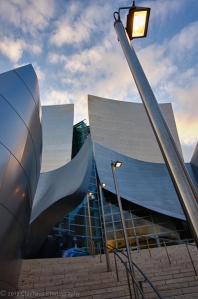
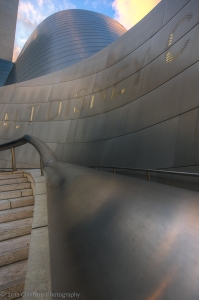
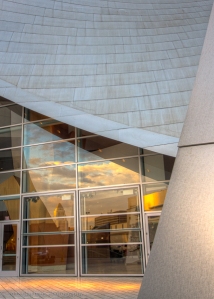
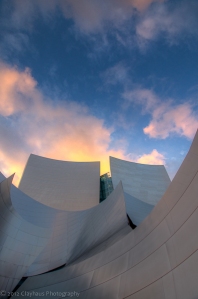
An Architect's Work is a Photographer's Pleasure
03 May 2012
Kelso Dunes: A Drive By
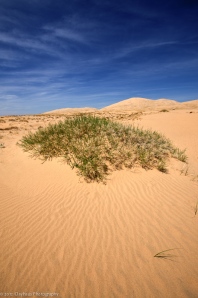
If anyone knows about the Kelso Dunes — and I’ll wager not many do — then they know that one just doesn’t happen to “drive-by” these 650 foot tall sand dunes. Instead, you must plan to go there, even if for only a half hour, as I did this week. The plan was to drive home (Salt Lake City) from my step-mother’s house in Southern California via the Mojave National Preserve rather than the shorter but tedious I-10 to I-15 interstate route. Why? Because I wanted to see — and briefly photograph — the Kelso Dunes again. First, and last, there some 29 years ago, I had memories of climbing to the top of dunes for a sunset with my then girlfriend. We had camped in the nearby Providence Mountains and the austere, dry quiet of the Mojave had awed both of us. This was before the Preserve was established and the State of California created the Providence Mountains State Recreation Area (which, along with another 60+ state parks has been embarrassingly closed due to ‘deficit-reduction’ since 2008) and so toodling around in the desert carried more risk then then it does now. The roads were much rougher and pavement was much sparser.Now, heading north into the heart of the Mojave Desert on the Kelbaker Road in my father’s VW Passat and listening to his old Doobie Brothers and Blood, Sweat & Tears cassettes (thinking of you dad), the experience and goal were of a different nature. Rather than camp and hike, I planned to drive and shoot. Climbing past the aptly named Granite Mountains and descending the long straight grade after the pass, there lay the long line of amber-ish colored dunes to the west and the short 3 mile long graded dirt road to the trailhead. Of course many a visitor to National Parks execute true drive-bys. You’ve seen them, yes? They drive-up, stop the vehicle, perhaps turn-off the engine (but, probably not), and hold their point-and-shoot or smart phone at arm’s length, snap the digital shutter, climb back in the vehicle and disappear, heading to the next scenic spot where they are supposed to take a picture. I witnessed the ultimate drive-by last year when at the end of Chicken Corners Road in the Greater Canyonlands area — a partially 4WD road that takes 3-4 hours to drive one-way — a woman in the passenger side of a rented open-air jeep, said “awesome, just awesome” as she snapped a couple of frames, whilst the jeep turned around, and headed home again. The jeep didn’t stop and she didn’t get out. Is that not strange behavior of homo urbis?I don’t really do true drive-bys, so grabbing my Pentax K-5 and my infrared modified Pentax K10, I started trudging towards the main dune in the 80 degree heat. No plan really other than to find a spot closer and perhaps nicer to shoot a few frames. After 15-20 minutes I found a few sand ripples and clumps of greenery and though it was late morning and the sun was harsh, I documented my desert side trip on the long journey home. The numerous creosote bushes were sporting small yellow flowers but the persistent breeze played havoc with any attempt to photograph them, so I didn’t. The four shots here, though perhaps borderline repetitive, will hopefully give one a feel for the unique nature of these plant-stabilized dunes. Reportedly the oldest dunes (~25,000 years) in North America, and the third highest (after the Great Sand Dunes in Colorado and the Eureka Sand Dunes in Death Valley National Park), the Kelso Dunes really deserve more than a drive-by.Next time.