




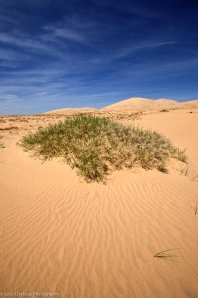
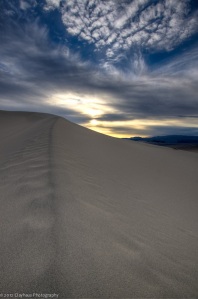
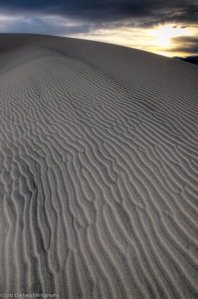
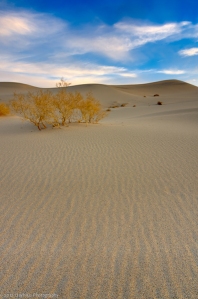
If anyone knows about the Kelso Dunes — and I’ll wager not many do — then they know that one just doesn’t happen to “drive-by” these 650 foot tall sand dunes. Instead, you must plan to go there, even if for only a half hour, as I did this week. The plan was to drive home (Salt Lake City) from my step-mother’s house in Southern California via the Mojave National Preserve rather than the shorter but tedious I-10 to I-15 interstate route. Why? Because I wanted to see — and briefly photograph — the Kelso Dunes again. First, and last, there some 29 years ago, I had memories of climbing to the top of dunes for a sunset with my then girlfriend. We had camped in the nearby Providence Mountains and the austere, dry quiet of the Mojave had awed both of us. This was before the Preserve was established and the State of California created the Providence Mountains State Recreation Area (which, along with another 60+ state parks has been embarrassingly closed due to ‘deficit-reduction’ since 2008) and so toodling around in the desert carried more risk then then it does now. The roads were much rougher and pavement was much sparser.Now, heading north into the heart of the Mojave Desert on the Kelbaker Road in my father’s VW Passat and listening to his old Doobie Brothers and Blood, Sweat & Tears cassettes (thinking of you dad), the experience and goal were of a different nature. Rather than camp and hike, I planned to drive and shoot. Climbing past the aptly named Granite Mountains and descending the long straight grade after the pass, there lay the long line of amber-ish colored dunes to the west and the short 3 mile long graded dirt road to the trailhead. Of course many a visitor to National Parks execute true drive-bys. You’ve seen them, yes? They drive-up, stop the vehicle, perhaps turn-off the engine (but, probably not), and hold their point-and-shoot or smart phone at arm’s length, snap the digital shutter, climb back in the vehicle and disappear, heading to the next scenic spot where they are supposed to take a picture. I witnessed the ultimate drive-by last year when at the end of Chicken Corners Road in the Greater Canyonlands area — a partially 4WD road that takes 3-4 hours to drive one-way — a woman in the passenger side of a rented open-air jeep, said “awesome, just awesome” as she snapped a couple of frames, whilst the jeep turned around, and headed home again. The jeep didn’t stop and she didn’t get out. Is that not strange behavior of homo urbis?I don’t really do true drive-bys, so grabbing my Pentax K-5 and my infrared modified Pentax K10, I started trudging towards the main dune in the 80 degree heat. No plan really other than to find a spot closer and perhaps nicer to shoot a few frames. After 15-20 minutes I found a few sand ripples and clumps of greenery and though it was late morning and the sun was harsh, I documented my desert side trip on the long journey home. The numerous creosote bushes were sporting small yellow flowers but the persistent breeze played havoc with any attempt to photograph them, so I didn’t. The four shots here, though perhaps borderline repetitive, will hopefully give one a feel for the unique nature of these plant-stabilized dunes. Reportedly the oldest dunes (~25,000 years) in North America, and the third highest (after the Great Sand Dunes in Colorado and the Eureka Sand Dunes in Death Valley National Park), the Kelso Dunes really deserve more than a drive-by.Next time.



It was one month shy of a quarter century since I had last been here. Easter week in 1987 we – my wife, our 7-year old daughter, and our 2-year old golden retriever – pulled into the lee of the 700+ foot tall Eureka Sand Dunes in our 1972 International Scout. The only other person there was some bozo riding a 3-wheeler on the lower dunes, fortunately in the distance. There was no campground, certainly no outhouse, and in fact Death Valley was still a Monument and its boundaries did not yet extend to this lonely and remote valley. Against a crystal blue sky we climbed the highest dune and later that night relished a warm evening beneath a canopy of limitless stars.
Fast forward 299 months…the Scout is long gone, Whiskey – our first golden retriever – lived a long life but is also no longer with us, our daughter is grown up, my wife was at home, and me and my friend / photography-partner finally arrived after a 10+ hour drive at the primitive Eureka Valley campground on this cold, cloudy March afternoon. Death Valley National Park extended its borders a decade-and-a-half-ago to include this valley, as well as Saline and Panamint Valleys. Other than fourteen or so widely scattered campsites, and the one lone sentinel of an outhouse, it was hard to see any difference in what I remembered from 25 years ago. Oh yes, no bozos are permitted to ride their toys on the dunes…progress.
It was chilly but after selecting a site and setting up camp, we ventured into the lower march of dunes to photograph a sandy sunset. Little time remained before the sun dipped below the horizon, and my goal was to hike high on a dune ridge to a) be beyond any traces and tracks of human footprints – always a challenge in the dune environment – and b) be positioned appropriately to capture the waning light on the dunes.
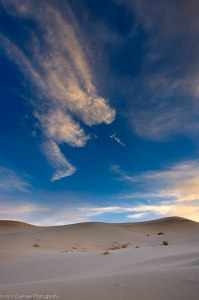
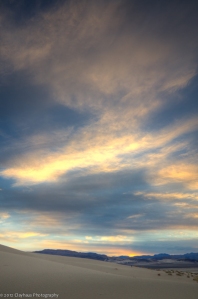
It didn’t take me long to clamber high enough to reach a stretch of virgin sand, long with sinuous cascades of ripples. The clouds played havoc with the light – a muted softbox effect punctured by occasional bright bursts of the sun and its light – and ultimately yielded little in the way of dramatic and classic sunset colors. Nonetheless, there were brief windows when things worked and the elements came together to create interesting images: a knife-ridge here lit by golden light on one side, shadowy dusk descending on the other; a thin, struggling bush there acting as an organic counter-point to the mountains of silky silica. I concentrated on those moments and subjects, attempting to distill the essence of cool spring dusk turning into the winter of a cold, starry night; trying to do justice to the power, beauty, and serenity of the desert environment.







Coming late to architecture, I had never heard of the Gamble House. But recently I was in the LA area for a quick architectural tour and my daughter suggested we check out this American Craftsman Style house of the Arts and Crafts Movement. Built in 1908 for David Gamble (of Proctor & Gamble fame) the house is outstanding from many perspectives. The architects – Greene & Greene – used an array of over 20 different woods. All of the furniture and finishings, including cabinets, picture frames and even a piano, were created in their millwork shop from original designs. Additionally, all of the lamps and wall sconces were individually designed. Throughout the entire house can be found an interesting interweaving of Japanese design and aesthetics with an American sense of spaciousness and the possible.
The only way to view the interior is via an hour long guided tour. It is worth it. The docent that led us was very well-versed in not only the minutiae of the Gamble family and their house, but he also knew much about the architect brothers. He also shared interesting details about life in the early 20th century. For instance, there was a fear in the early days of electricity that direct exposure to light bulbs would be harmful. That is why all of the light bulbs are pointing upwards or otherwise shielded from direct view. Those deadly photons!
The house is essentially a working museum. The last Gamble lived there until 1966 and then the building and grounds were donated to the city of Pasadena. Through a special arrangement with USC, two senior architecture students live and study there every year. With little change, things are the way they were a 100 years ago.
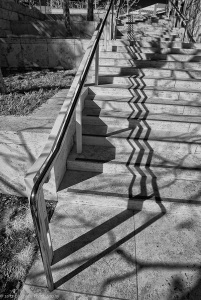
From a photographic perspective, the interior is relatively low-lit, due to the pervasive light-dampening characteristics of all the dark woods. Some long exposures would be wonderful but photography is off-limits inside. When I was there it was mid-day and the light was pretty harsh. Nonetheless, I took a few color and infrared shots of the west-facing exterior. I believe the infrared converted to b/w images work the best. I took multiple exposures and blended them together which allowed for a rich depth of tones in the shadows and well-lit areas. The color images are less interesting to me, but I offer them as a juxtaposition.
If you love architecture and are in the LA area, you owe it to yourself to check out the Gamble House. If you have more time, there are several more Greene & Greene homes within walking distance, along the Arroyo Terrace. Discovering an architectural gem in the built environment can be almost as rewarding as exploring the wilderness. Almost.


