Showing posts with label buildings. Show all posts

13 April 2013

Travels with Oka-san | Tokyo Deluge

 After six hours of restful sleep, I feel ready for Tokyo.

I meet mama-san for what I swear will be my last Western-style breakfast in Japan and by 8 we are out the hotel door and ready for adventure. A light drizzle greets us but we remain undeterred from our day's goals: the Imperial Palace gardens and a stroll through Ginza.

For almost 300 years, until the Meiji restoration in 1868, the Tokugawa Shoguns governed Japan from their castle in Edo, modern-day Tokyo. Once the shogunate was deposed, the Emperors ruled from the castle. Nothing lasts forever though, and World War II saw the almost complete destruction via aerial fire-bombing of the palace, and indeed, most of Tokyo itself. Following the war, the palace was rebuilt and gardens re-planted. The emperor and imperial train still reside there, though 'ruling' is no longer their role. The buildings and inner gardens are not open to the public, however the extensive outer gardens are open for strolling. With a few remnants of the original walls, ponds, extensive trees and walkways mixed with splashes of flowering color, stolid rocks, and the occasional restored traditional building, the gardens are usually teeming with tourists and natives alike, seeking quiet respite from the modern chaos that is Tokyo.

By the time we emerge from our short subway ride and the long, underground walkway tunnel from the station to the Imperial grounds, the word 'teeming' can only be applied to the rain falling. From drizzle to torrents in short order. Donning rain-jackets and opening umbrellas we are ready for what Tokyo is gives us...I just wish I had galoshes with me as well. 

It is hard to see the smoking ruin that we left Tokyo in 1945 for all the green now around us. Once again a reminder that re-growth and rejuvenation can always be possible, is, in fact, the 'natural' order of things, given time. The exquisitely built bashōs (guard houses) and tea pavilions, lovely ponds (with obligatory koi), swan-adorned moats and sculptured walkways transport one far away from the proverbial hustle and bustle outside the grounds. It is a pleasure exploring and despite the continuing, actually relentless, downpour, we are refreshed by what we see.

To a point. After a couple of hours, the completely soaked through shoes begin to chill as the squeege-squeege sounds of walking begin to annoy. The thoughts of food, hot tea and warm shelter entice. Where to go on such a beastly day? Mitsukoshi of course! The grand dame of Japanese department stores. The Harrod of the East (never mind American upstarts like Macys or Nordstroms), Mitsukoshi was founded in 1673 and began by selling kimonos. Now a huge conglomerate, the main store in the Nihonbashi area, is just a few steps from the Imperial grounds.

After beating our way through a few blocks of torrential downpours, we arrive at our destination. Petite Japanese women in matching uniforms bow and greet the soggy patrons as they enter, including us, the soggiest of the lot. We wander through ten floors, admiring the Japanese aesthetic in the various displays, and prices, not for the faint of heart. There are restaurants on the 4th, 5th, 7th, and 10th floors and when we finally choose one, the warming donburi ramen and tea are just what we need.

Fortified, we set out to wander more floors of this teeming shopping metropolis and stumble quite accidentally upon a floor with the 54th annual exhibit of Japanese handicrafts. Beautiful colorful kimonos, stunning displays of pottery, intricate baskets, and finely wrought lacquer ware greet us as we move from room to seemingly endless room. We could, as I am sure many locals did, spend the entire rest of the day wandering through the department store-cum-museum, but instead we elect to weather the weather once again.

Stepping outside, the rain has mercifully let up and we beginning walking towards the Ginza District. First we must cross the Nihonbashi. "Japan Bridge" was originally Edobashi in the 1600s, a wooden bridge that was the beginning — or ending, depending upon your direction — of the ancient Tōkaidō road between Edo and Kyoto. From this bridge, once upon a time, travelers heading south could see Mt. Fuji. Renamed and rebuilt with stone in the Meiji period and now more or less covered by an expressway, one could cross the Nihonbashi and be forgiven for not immediately grasping its historical significance.

Ginza, now known the world-over as one of the most upscale of botiqueries and shopping areas, got its start in the early 17th century as the location of the silver mint for the shogunate. Appropriate, as anything you buy on this street will cost you that said mint. We are not here to shop though, but instead to stroll and soak in the experience. We luck out as on Sunday — during the daylight hours — the main Ginza drag has been turned into a pedestrian-only zone. Walking the normally frenetic streets with casually strolling Japanese, umbrellas on shoulders, is a visual and photographic treat.

We eventually end up back at our hotel and after freshening up — and changing our thoroughly sodden shoes for dry ones — we venture back out for dinner and the nighttime version of Ginza. Dinner was superb: sushi, tempura, rice with fish and sake, all in a small, crowded restaurant where we are the only English speakers. Perfect.

After few photos of Ginza at night, the long day finally takes its toll on us: sleep, sleep and the next day...a new adventure.
Underground Walkway from Shinbashi Train Station

Imperial Palace Walls

Basho or Guardhouse

Castle Walls

Imperial Gardens

Imperial Gardens

Imperial Gardens

Imperial Gardens

Imperial Gardens

Walkway to Tea House

Tea Pavilion

Imperial Gates

Imperial Swan

Gates sans Tourists

Nihonbashi

Ginza

Ginza

Ginza

Ginza

Ginza
Ginza

Ginza

Ginza

Ginza

Ginza

Too much sake


02 April 2013

Travels with Oka-san | Departure and Arrival
In 2007 I traveled to Japan with my mother. That year my wife — who is usually my traveling partner — and I had already journeyed to Sicily in the spring and Iceland in the fall. She was not up for another international trip but my mom was. Of course the Japanese are too polite to inquire about personal relationships, but I thought it was still important to learn this phrase: "Kore wa watashi no oka-san"..."This is my mother." 

My wife and I will finally visit Japan together later this year and in the process of planning that trip I came across my old journal from my travels with oka-san almost 6 years ago. I thought it would be interesting to serialize that trip with a number of Clayhaus Ruminations posts...tanoshimu!


In a Yellow Cab driven by a Haitian immigrant, watching a beautiful orange and blue fall sunrise, I head to to the airport. I do wish Bonnie was sitting beside me — as she normally would be — but I am looking forward to two weeks in Japan with oka-san. Tokyo, Nikko, Takayama, Kyoto, Nara and finally Kamakura are on our agenda. And between sushi and sake, imperial castles and shogunate memorials, Buddhist temples and Shinto shrines, bullet trains and ancient paths, I know we will have very memorable trip.

My flight to LAX is uneventful and after a couple of hours waiting in NWA's equivalent to Delta's Crown Room [in those days Northwest Airlines still existed and I was corporate traveler with beaucoup de Skymiles], mama-san finally shows up.

I have a most excellent seat on the plane — aisle, exit row, and no one in front of me — and mom lucks out as the Japanese guy next to me exchanges his seat for mom's. I doubt I would have done the same, but his karma bank is surely fuller than mine!

Considering the vast expanse of water we must cross, the flight seems relatively short: "only" eleven hours. It is smooth as well and I catch a few cat-naps — though no deep sleep — in between studying some Japanese and processing images from my last and very different trip: to Iceland.

Arriving in Narita in the late afternoon of the next day we are struck by how quiet the airport is...eerily so. Immigration and customs are a breeze and once the luggage is gathered up (always a stressful few minutes: Did my bag make the connection? And, if it didn't, how will it ever be delivered to me?) we troop over to the Japan Railways (JR) office where we exchange our rail vouchers for passes. [The JR pass is a convenient and usually cost-effective way to travel about the country.] The JR staff are incredibly pleasant, efficient, and helpful. I have a feeling that this is going to be a common refrain.

On our way to our train I find a watch and for a moment think about keeping it. Second thought: what would the Japanese do? Return it, which I did, to the ticketing agents. Note to self: while in Japan, score many karma points.

Later, whilst waiting to board the train to Tokyo, I see an Indian gent frantically looking for...something. A few minutes later he returns, big smile planted on face, holding his — and mine, so briefly — watch. I think of saying something to him, but why? No, let it go and perhaps be a bit of a happy mystery to him.

Oka-san
The train ride into Tokyo is mercifully brief: just about one hour. We emerge from the Shimbashi train station to night time. Despite never having been here before, despite not really having slept since who knows when, despite being confused as to whether it really should be night or day, despite not seeing any sign I can read, I feel damn sure I know which way our hotel is. Pointing yonderly we start out on foot through a maze of busy streets and then into a kind of corporate wasteland. The wasteland being the modernist Shiodome area that at this time of night has been pretty much abandoned to the wandering and potentially lost gaijin tourists seeking hotel refuge. Seek and ye shall find and more or less directly we find our lovely Park Hotel.

Park Hotel, Tokyo
Clean, simple, non-fussy elegance greets us in the lobby as we step out of the elevator on the 25th floor of the Shiodome Media building. Shortly we ride the elevators higher and though our rooms are small, they are comfortable with the famous Toto toilets and razors, slippers and PJs.

It seems past time for dinner so I ask the concierge where we might find a restaurant open. He says "Why not eat in our restaurant?" Why not indeed! The food is exotic and wonderful and satisfying and yes, very tasty. I am going to like eating in Japan! 

After dinner I feel my usual travel-related restlessness and we wander outside for a quick stroll. Neither of us lasts long and tiredness descends as quickly as our elevator rises. Sleep and a comfortable bed beckon and I yield.  

04 December 2012

The Mystery of Castello dei Conti Ubertini

Castello dei Conti Ubertini...what were you?


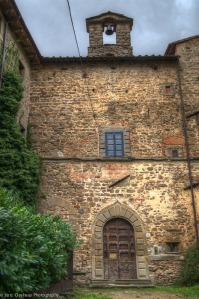
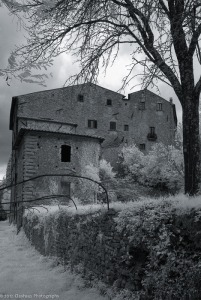
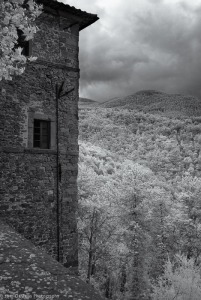
Heading into the Casentino Valley via the twisty-turny Strada Provinciale 60, shortly after the hamlet of Chitignano is a narrow, dirt one-way road on the left with a rusted yellow sign next to it. “Castello dei Conti Ubertini Sec XII” it intones. A castle, 12th century...what’s not to like? Down the lane after about 100 meters is an open field and the rambling hulk of the castello, bordered by green and yellowing trees. Not the classic form of a castle, per se, but rather a pile of irregular rectangular stone boxes stacked helter-skelter. Old yes, twelfth century, perhaps, somewhere. But what I see is a contagion of styles and centuries. What it was, is clearly not what it is.

 Castello dei Conti Ubertini...what are you?

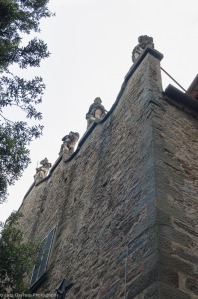
On the southern perimeter is an old wall and perhaps a ditch. Was this part of some long-lost defensive design? On the north side the narrow ribbon of a lane continues, cast in shadow by the tall, overgrown trees and the looming outer façade of the structure. Structures with a plural ‘s’ is likely more accurate as there are clearly multiple buildings that have grown together in some organic though seemingly chaotic fashion. Walking up the lane and into the shadows, heavy fortified windows peer downward whilst higher, mounted on a decoratively curving upper wall, stand six to seven Renaissance figures. The angle is so acute that I cannot guess whether the figures are male or female, filled with gaiety or glowering with menace. They are just there and probably have been for some 400 years.

Castello dei Conti Ubertini...what are you?

Passing through the stalwart portal, the light goes dim as the think walls shield from sun and arrows alike. On the inside are gun ports offering a wide range of fire on potential hostile guests. Into the main courtyard — for clearly that’s what it was — I can now see how complete the transition has been from ancient castello to working villa. There is a barn-like structure to the west, on the brow of the hill and the portal I passed through is now part of three story living quarters. What affairs — both intimo and politico — have been conducted behind those green shutters? Did troops mill about or bivouac under smoky fires in this courtyard? Did clerics argue and prattle on about holy business whilst enjoying the Tuscan sun and perhaps a glass of the local quaff? The main entrance lays before me: a heavy brown door, protected by a gun port, a door bell, and above, a belfry. No Proprietà Privata or the even more ubiquitous Attenti al Cane signs decorate the castle walls, so I feel free to loiter and linger a bit longer. Treading back down the lane whilst the blustery wind kicks brown leaves into mini whirlpools, I can only wonder...

Castello dei Conti Ubertini...what were you?

----------------------------------

With roots extending over a millennia, the castle is recorded to having belonged to the Count of Chiusi (an old Etruscan town) in the early 13th century. In 1262 it passed into the control of the Counts of Ubertini. Ghibelline supporters of the Holy Roman Emperor, they were defeated at the Battle of Campaldino in 1280 by the Guelph (supporters of the Pope) Florentine forces and the castle (and much of the Ubertini possessions) passed to the Bishop of Arezzo and the Guidi family of Florence. The castle was restored (modernized) in the 16th century and though it is now privately owned, with prior arrangements it may be toured.

Clayhaus-clay7379-editClayhaus-imgp3388_nik-editClayhaus-imgp3391_2_3-edit-editClayhaus-imgp3398_399_400-editClayhaus-imgp3401_2_3-editClayhaus-imgp3407_8_9-editClayhaus-imgp4735-editClayhaus-imgp4742-editClayhaus-imgp4744-editClayhaus-imgp4738-edit