02 April 2013

Travels with Oka-san | Departure and Arrival

In 2007 I traveled to Japan with my mother. That year my wife — who is usually my traveling partner — and I had already journeyed to Sicily in the spring and Iceland in the fall. She was not up for another international trip but my mom was. Of course the Japanese are too polite to inquire about personal relationships, but I thought it was still important to learn this phrase: "Kore wa watashi no oka-san"..."This is my mother." 

My wife and I will finally visit Japan together later this year and in the process of planning that trip I came across my old journal from my travels with oka-san almost 6 years ago. I thought it would be interesting to serialize that trip with a number of Clayhaus Ruminations posts...tanoshimu!


In a Yellow Cab driven by a Haitian immigrant, watching a beautiful orange and blue fall sunrise, I head to to the airport. I do wish Bonnie was sitting beside me — as she normally would be — but I am looking forward to two weeks in Japan with oka-san. Tokyo, Nikko, Takayama, Kyoto, Nara and finally Kamakura are on our agenda. And between sushi and sake, imperial castles and shogunate memorials, Buddhist temples and Shinto shrines, bullet trains and ancient paths, I know we will have very memorable trip.

My flight to LAX is uneventful and after a couple of hours waiting in NWA's equivalent to Delta's Crown Room [in those days Northwest Airlines still existed and I was corporate traveler with beaucoup de Skymiles], mama-san finally shows up.

I have a most excellent seat on the plane — aisle, exit row, and no one in front of me — and mom lucks out as the Japanese guy next to me exchanges his seat for mom's. I doubt I would have done the same, but his karma bank is surely fuller than mine!

Considering the vast expanse of water we must cross, the flight seems relatively short: "only" eleven hours. It is smooth as well and I catch a few cat-naps — though no deep sleep — in between studying some Japanese and processing images from my last and very different trip: to Iceland.

Arriving in Narita in the late afternoon of the next day we are struck by how quiet the airport is...eerily so. Immigration and customs are a breeze and once the luggage is gathered up (always a stressful few minutes: Did my bag make the connection? And, if it didn't, how will it ever be delivered to me?) we troop over to the Japan Railways (JR) office where we exchange our rail vouchers for passes. [The JR pass is a convenient and usually cost-effective way to travel about the country.] The JR staff are incredibly pleasant, efficient, and helpful. I have a feeling that this is going to be a common refrain.

On our way to our train I find a watch and for a moment think about keeping it. Second thought: what would the Japanese do? Return it, which I did, to the ticketing agents. Note to self: while in Japan, score many karma points.

Later, whilst waiting to board the train to Tokyo, I see an Indian gent frantically looking for...something. A few minutes later he returns, big smile planted on face, holding his and mine, so briefly — watch. I think of saying something to him, but why? No, let it go and perhaps be a bit of a happy mystery to him.

Oka-san
The train ride into Tokyo is mercifully brief: just about one hour. We emerge from the Shimbashi train station to night time. Despite never having been here before, despite not really having slept since who knows when, despite being confused as to whether it really should be night or day, despite not seeing any sign I can read, I feel damn sure I know which way our hotel is. Pointing yonderly we start out on foot through a maze of busy streets and then into a kind of corporate wasteland. The wasteland being the modernist Shiodome area that at this time of night has been pretty much abandoned to the wandering and potentially lost gaijin tourists seeking hotel refuge. Seek and ye shall find and more or less directly we find our lovely Park Hotel.

Park Hotel, Tokyo
Clean, simple, non-fussy elegance greets us in the lobby as we step out of the elevator on the 25th floor of the Shiodome Media building. Shortly we ride the elevators higher and though our rooms are small, they are comfortable with the famous Toto toilets and razors, slippers and PJs.

It seems past time for dinner so I ask the concierge where we might find a restaurant open. He says "Why not eat in our restaurant?" Why not indeed! The food is exotic and wonderful and satisfying and yes, very tasty. I am going to like eating in Japan! 

After dinner I feel my usual travel-related restlessness and we wander outside for a quick stroll. Neither of us lasts long and tiredness descends as quickly as our elevator rises. Sleep and a comfortable bed beckon and I yield.  

23 February 2013

A Thing and its Meaning


Strolling along the Danube promenade our first day in Budapest, we came upon a puzzling display of cast-metal shoes, clearly of the 1940′s vintage. They were fixed to the cement of the walkway and designed to look like the owners had just thoughtlessly left them there, cast-off and in disarray. There were men’s and women’s and small shoes for children. I thought it was an art installation of some sort. There are many of those in Europe, usually of a whimsical nature, designed to bring a smile. We played along with that thread and I had my traveling companions stick their feet in amongst the lost shoes while I took a few photos. 

I was seeing one thing but not its meaning. They are a memorial and as such are designed to bring tears not a smile to the face. The sixty pairs of shoes represent the uncounted Jews (and their supporters) that were shot and pushed into the river during the Arrow Cross (Hungarian Fascists) terror of 1944-45. 

I see the thing and now I cannot see it but for it’s meaning. What compels people to do such things? What were the victim’s last thoughts, standing naked and shivering, awaiting that bright flash. Incomprehensible. And though I am saddened by what it represents, we must also never forget, and for that, I am also thankful.

16 February 2013

Mýrdalsjökull, Reynisdrangar and Dyrhólaey...oh my!

Imgp2554-editImgp5738-editImg_0286_5_4_3-editImgp5816-editImgp5827-au-dbImgp5744-auImgp5747-editImg_0302-editImgp2458-editImgp5840-editImgp2479-edit

In our last post -- What's in a Name -- we left off with discussing Katla, one of the more violent volcanoes along the Mid-Atlantic Ridge. Capping Katla is the ~600 sq. km. glacier called Mýrdalsjökull. Looking at a map of Iceland you will see some some eleven jöklar (plural for jökull, which by the way is pronounced 'yokel', more or less, and other than that, has no resemblance to our local breed) scattered about the island. They cover about 11% of the country's landmass and a jökull is of course a glacier. However, due to global warming, all of the glaciers are in rapid retreat. The largest, at around 8,300 sq. km in size, is losing about 4 km. per year.
Now we know what a is but what is 'Mýrdals?' If you remember from the previous post, the coastal town of Vík is actually formally know as Vík í Mýrdal. The latter word translates into English as 'mire dale.' Those are two words you are more likely to run across in Lord of the Rings rather than Facebook, as they are the more antiquated forms of 'boggy' or 'swampy' or 'marsh valley.' Mýrdalsjökull = Glacier of the boggy valley and Vík í Mýrdal = bay of the marshy valley. The reason for all the mud is the fact that the region receives up to 90 inches of rainfall annually.

Close by Vík are a set of basalt sea stacks known as Reynisdrangar. They rise from the stormy north Atlantic sea like the petrified masts of some ancient man-o-war. In fact, there are three similar legends related to them and at least two feature a ship. The most colorful tells the story of three trolls -- Skessudrangur, Laddrangur and Langhamar (but I think of them as Larry, Moe and Curly) -- who, whilst trying to drag a ship to shore, are caught, turned to stone and frozen in time and place by the rays of the dawn's sun. The stacks are very photo-genic from either the black basalt sand beach to the east or the high cliffs of Reynisfjall, directly above. If the weather is relatively calm (all things being relative here), you can lie upon the edge of the cliffs watching the puffins wheel about in the void between you and the stone trolls.

From those same cliffs, much further to the west, a headland thrusts into the sea, with a quite large puncture mark in the rock. Dyrhólaey it is, meaning, "the hill-island with the door-hole." Tour boats will float through the opening and a stunt pilot is said to have flown through it as well. The cliffs are crowded by puffins and the view from the edge of the promontory is spectacular if not vertiginous.

A little ways inland and with a peaceful gaze at both Dyrhólaey and Reynisdrangar, is Loftsalahellir, "upper chamber cave." Before the Vikings began arriving in the 800's it is rumored that Irish monks seeking "green martyrdom" in the time of St. Patrick (6th-7th century) voyaged to Iceland to live solitary lives of hermits. No physical trace that I am aware of has been found of these monks. Perhaps their lives were so devoid of any physical comfort and artifices that all has been obliterated by time and the elements. Or, perhaps it is all just a myth. Regardless, an Irish monk was said to live in this cave, Loftsalahellir, sometime before the Icelandic Sagas place Viking council meetings there. Either way, it makes a lovely spot to have lunch as well as end this 'saga' of a blog post.

Bless í bili

30 January 2013

What's in a Name?

Clayhaus-imgp5721-editClayhaus-img_0290_89_88_87-editClayhaus-img_0320-edit-editClayhaus-imgp2660-editClayhaus-imgp2657-editClayhaus-imgp2559-editClayhaus-imgp2554-2555

The passion for naming things is an odd human trait. Many a scientist claims to have explained some phenomenon when in truth all he has done is to give it a name.

— George Gaylord Simpson


Once you label me you negate me. — Soren Kierkegaard


You can know the name of a bird in all the languages of the world, but when you're finished, you'll know absolutely nothing whatever about the bird... So let's look at the bird and see what it's doing -- that's what counts. I learned very early the difference between knowing the name of something and knowing something. — Richard Feynman


Rose is a rose is a rose is a rose. — Gertrude Stein


Gertrude said it most succinctly and perhaps most elegantly. A thing is what it is, not what it is called. Yet, the ancient Chinese proverb — The beginning of wisdom is to call things by their right names — intimates that words do matter. Perhaps the Chinese were conflating wisdom with knowledge, for clearly names are important in knowledge whilst wisdom tells us that a rose is indeed a rose.


Recently I began reprocessing images of a trip to Iceland I took some years back. I started labeling the images with more specificity than just “Iceland,” and began wondering about Mýrdalsjökull, Hjörleifshöfði, Reynisdrangar and other tongue-twisting place-names I was finding on my maps. Is there a history behind the name? Does the name mean something? Is a rose truly just a rose? Or, in the case of Iceland, is a vík a vík.


On the southern most nub of Iceland’s coast is a small village of some 300 souls. It’s full name is Vík í Mýrdal, but everyone calls it simply Vík. Cast your eyes on a map of Iceland and scattered around the coast of the island you will find other víks: Keflavík, Grindavík, Ólafsvík, and of course the most famous vík of them all, Reykjavík. What’s with all the víks? It is not, strictly speaking an Icelandic word but rather Old Norse for ‘cove’ or ‘bay.’


Some 15 kilometers east of Vík is the isolated 220 meter high headland of Hjörleifshöfði. Named after the Viking Hjörleifur Hróðmarsson, who settled there in 874, the small mountain was once a much larger promontory.  Successive eruptions of the mighty Katla over the eons has caused so much flooding and carrying away of rock that Hjörleifshöfði stands isolated, a mile and a half from the sea. Returning to Mr. Hróðmarsson, apparently he was not a good provider as a year after settling on the rock his slaves revolted killing him and his free men. He is said to be buried at the highest point of the hill. His farmstead was clearly visible next to the rock for over a thousand years until the 1918 eruption of Katla finally washed away the remnants.


The cause of all these volcanic disturbances lies some 20 kilometers north of Vík (as the puffin flies). Katla (derived from the Old Norse word for ‘kettle,’ the shape of which upside-down the volcano is) is a large, very active volcano partially covered by the Mýrdalsjökull glacier. It has erupted 20 times since 930 AD and is due for another, any time now. The flood waters created by one eruption is estimated to have been comparable to the combined output of the Amazon, Mississippi, Nile, and Yangtze rivers. Not something one would like to be caught in. In old days, traveling along the southern coast was greatly feared because of the deep rivers and frequent glacial floods. In July of 2011 there was a small eruption on Katla that created a jökulhlaup (glacial ‘leap’ or glacial outburst flood) that destroyed the bridge across the main highway. Watch this short video and at the :34 mark you will see Hjörleifshöfði in the distance.


[youtube http://www.youtube.com/watch?v=oQlkGO5KsPY?rel=0]


Next: Mýrdalsjökull, Reynisdrangar and Dyrhólaey


03 January 2013

The Þjórsá and Dam Battles

The mighty Þjórsá (loosely pronounced Thyor-sah) is Iceland's longest river at 230 km. Flowing turbulently down from the central highlands icecap of Hofsjökull, the Þjórsá is a classic glacial river, cutting deep ravines through lava fields, ancient and modern, and stepping through waterfalls on its way to the island’s southern coast. When we were there several Julys ago, the river was turgid and yellowish-green with silt and mud. The intensity and force of the river was most apparent at Þjófafoss, the relatively short waterfall that sits picturesquely at a bend in the river, the 2200’ high volcano Búrfell beyond. Þjófafoss means ‘Thieves Falls’ as supposedly medieval cutpurses were chucked off the ledge overlooking the swirling, foamy mass below. Not pleasant, but probably pretty quick. Búrfell, with bright green vegetation climbing up its steep lava-strewn slopes, makes a wonderful backdrop for exploring or photography. To the east the fearsome Hekla rises to almost 5000 feet. One of the most active volcanoes in Europe, Hekla was considered the literal gateway to Hell during the Middle Ages. Between 1970 and 2000 it erupted every 10 years...its overdue based on that schedule.

Further upstream 2 or 3 kilometers and spanning the river is the Tröllkonuhlaup (The Giantess Waterfall). The legend states that a female troll (giant) lived in a cave in Búrfell and wanting to cross the river without getting wet, threw boulders into the Þjórsá as stepping-stones. Whatever the myth, the low falls make a great backdrop for having lunch.

Upon planning a return trip to Iceland I was dismayed to read that the Icelandic government in concert with an energy consortium want to build three dams on this river. Now, I will be the first to admit that I am not an expert on Iceland’s energy needs, but viscerally I look at this river and wonder what ‘they’ can be thinking. Even more so when I read that no environmentalists were involved in the initial plan drafting, only government officials and energy companies. Sound familiar? Fortunately the planned three dams have been put on hold, though perhaps that is just a waiting game.

Though our climate is very different than Iceland’s, we too in the arid Southwest have had our dam battles. At one time Floyd Dominy, Bureau of Reclamation commissioner (1959-69), and others, wanted to build a series of dams on most western rivers. They were successful to a point but were finally stopped at the doorstep of the Grand Canyon. Many want to rollback the industrialization of the desert by removing Glen Canyon Dam.

As simplistic and unfortunate as it may be, many facets of our current politico-socio clime can be defined by the term ‘culture wars.’ This is true too when discussing the role of humankind vis-à-vis nature. To take us out of the nature equation is unrealistic and frankly, unnatural. But even more so, the claim that we can ‘improve’ on nature is laughable. We may improve our position of dominance within nature, but that is not improving nature. These are really different and opposing viewpoints. I look at the Colorado River flowing through Greater Canyonlands, or the Þjórsá winding its way through Iceland’s volcanic lowlands, and I see wilderness and want to leave it be. The Floyd Dominy’s and Landsvirkjun’s (Iceland’s national energy company) of the world see lands and waters and resources to overcome, manage, and 'improve' upon. We’ve had a lot of the latter the last 200 years or so, with benefits and boondoggles and disasters aplenty. Growth for the sake of growth is the ethos of the cancer cell. Now is the time to manage our own nature and leave Nature be.
Clayhaus-imgp1876-cln-vf-edit-editClayhaus-imgp1877-editClayhaus-img_0197-editClayhaus-imgp1882-editClayhaus-img_0200-editClayhaus-img_0206-editClayhaus-imgp1884-editClayhaus-img_0202-editClayhaus-img_0204-editClayhaus-imgp1899-editClayhaus-img_0211-edit

04 December 2012

The Mystery of Castello dei Conti Ubertini

Castello dei Conti Ubertini...what were you?


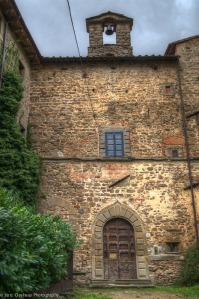
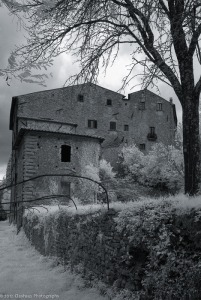
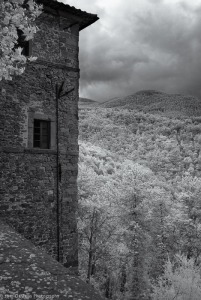
Heading into the Casentino Valley via the twisty-turny Strada Provinciale 60, shortly after the hamlet of Chitignano is a narrow, dirt one-way road on the left with a rusted yellow sign next to it. “Castello dei Conti Ubertini Sec XII” it intones. A castle, 12th century...what’s not to like? Down the lane after about 100 meters is an open field and the rambling hulk of the castello, bordered by green and yellowing trees. Not the classic form of a castle, per se, but rather a pile of irregular rectangular stone boxes stacked helter-skelter. Old yes, twelfth century, perhaps, somewhere. But what I see is a contagion of styles and centuries. What it was, is clearly not what it is.

 Castello dei Conti Ubertini...what are you?

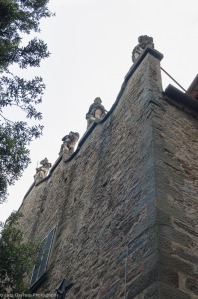
On the southern perimeter is an old wall and perhaps a ditch. Was this part of some long-lost defensive design? On the north side the narrow ribbon of a lane continues, cast in shadow by the tall, overgrown trees and the looming outer façade of the structure. Structures with a plural ‘s’ is likely more accurate as there are clearly multiple buildings that have grown together in some organic though seemingly chaotic fashion. Walking up the lane and into the shadows, heavy fortified windows peer downward whilst higher, mounted on a decoratively curving upper wall, stand six to seven Renaissance figures. The angle is so acute that I cannot guess whether the figures are male or female, filled with gaiety or glowering with menace. They are just there and probably have been for some 400 years.

Castello dei Conti Ubertini...what are you?

Passing through the stalwart portal, the light goes dim as the think walls shield from sun and arrows alike. On the inside are gun ports offering a wide range of fire on potential hostile guests. Into the main courtyard — for clearly that’s what it was — I can now see how complete the transition has been from ancient castello to working villa. There is a barn-like structure to the west, on the brow of the hill and the portal I passed through is now part of three story living quarters. What affairs — both intimo and politico — have been conducted behind those green shutters? Did troops mill about or bivouac under smoky fires in this courtyard? Did clerics argue and prattle on about holy business whilst enjoying the Tuscan sun and perhaps a glass of the local quaff? The main entrance lays before me: a heavy brown door, protected by a gun port, a door bell, and above, a belfry. No Proprietà Privata or the even more ubiquitous Attenti al Cane signs decorate the castle walls, so I feel free to loiter and linger a bit longer. Treading back down the lane whilst the blustery wind kicks brown leaves into mini whirlpools, I can only wonder...

Castello dei Conti Ubertini...what were you?

----------------------------------

With roots extending over a millennia, the castle is recorded to having belonged to the Count of Chiusi (an old Etruscan town) in the early 13th century. In 1262 it passed into the control of the Counts of Ubertini. Ghibelline supporters of the Holy Roman Emperor, they were defeated at the Battle of Campaldino in 1280 by the Guelph (supporters of the Pope) Florentine forces and the castle (and much of the Ubertini possessions) passed to the Bishop of Arezzo and the Guidi family of Florence. The castle was restored (modernized) in the 16th century and though it is now privately owned, with prior arrangements it may be toured.

Clayhaus-clay7379-editClayhaus-imgp3388_nik-editClayhaus-imgp3391_2_3-edit-editClayhaus-imgp3398_399_400-editClayhaus-imgp3401_2_3-editClayhaus-imgp3407_8_9-editClayhaus-imgp4735-editClayhaus-imgp4742-editClayhaus-imgp4744-editClayhaus-imgp4738-edit

18 November 2012

Casa Cappellino and the Tuscan Countryside

The virtues and pleasures of visiting Tuscany have been well documented since at least the early 19th century. In the Romantic Age, poets and writers, artists and hangers-on alike wandering the Tuscan countryside, prowled the narrow alleys of medieval villages, wiled away hours in the wide piazzas of Florence and Siena. Somewhere between drinking and frolicking, they sang and wrote and painted about the beauties and vicissitudes of Tuscany and the Tuscan people. The years have been kind and terrible to Tuscany. Two millennia of on-again/off-again warfare built cities and towers and bridges and castles, and then tore them down again, only to see them rise again in some fashion. Post the last devastating war, Italy, like much of Europe, experienced yet another assault: modernization. And, like everywhere, this has been a mixed blessing. Many of the smaller charms of Florence are subsumed under the crush of traffic, human and mechanized. Graffiti and fast food chains cheapen 500 year old strade and during the high season the lyrical beauty of Italian is lost amongst the babble of tourists. But, it IS still Tuscany: a place of wonderful food and wine, charming and unspoiled villages, friendly people, and unmatched historical, cultural and artistic treasures. It is a diverse land: beaches rising to the bright green Chianti hills and rising further still to the darker Apennine mountains, fount of both the Arno and Tiber Rivers. So, it is a place one must eventually go to. For us, it is a place of return.


Eleven plus years ago in a small café in Montalcino (tucked away in southern Tuscany) we watched the events of September 11, 2001 unfold on a small Italian TV. Though we completed our two week trip through Tuscany and Umbria, it and us had been changed, as indeed the world was. In the ensuring decade we continued our travels including Italian trips to Rome and Venice, the Lake regions and the Dolomites, Umbria, le Marche and far-south Sicily. In the back of my mind was always a return to Tuscany. We wanted to ‘do’ Florence at least semi-properly by staying in the city. We love Siena and a return there seemed a must. I wanted both to better photograph what I had seen before – San Gimignano, Monteriggione, Montepulciano – and see and shoot new Tuscan delights: Pisa, Lucca and Volterra. Perhaps we would even have a cup of espresso or a glass of Brunello in that little café in Montalcino, where we had spent several hours, or perhaps a lifetime.  

Our plans changed when fortune and Facebook intersected. We became re-connected with a friend from 20 years ago with whom we had long lost touch. Our friend Dennis had purchased a Tuscan villa and retired to it. After looking at villas in the Volterra area, I turned to Dennis’ Casa Cappellino (‘Little Hat House’ in Italian). What a beautiful piece of property (all 6 acres of it) with a small working vineyard, a natural spring fountain, ducks, chickens and rabbits bounding about, a reticent cat named Min and a friendly and loving sheepdog named Max. Of course, the real clincher for us was the beautifully restored 2-bedroom farmhouse that we would be staying in.


This would be a different trip than what I had originally envisioned. Casa Cappellino is nestled above in the little wooded hillside hamlet of Lama, about as far east of Florence as Pisa is west. With the borders of Emilia-Romagna, Le Marche and Umbria close by, the appealing destinations of Ravenna, Urbino and Perugia are about as accessible as Florence and Siena. Much closer to ‘home’ and seen from our bedroom window is the small hilltop birthplace of Michelangelo, Caprese Michelangelo. In the valley below Lama flows the Tiber, beginning its journey to distant Rome. The river passes by or through a number of historically and artistically-important towns such as Sansepolcro and Anghiari. Behind the villa the hills rise steeply through a mix of chestnut, maples, ash and oak woods to reach heights where spruce and other firs reign. High on the ridgeline sits the medieval Franciscan monastery of La Verna, where St. Francis was reported to have received his Stigmata. Hiking trails abound in this area and offer incredible views both eastward into the Lama Plain and westward into the Casentino Valley, which is studded with hilltop castles and where the Arno River flows.

Further south, but no more than 45-60 minutes away is the ancient city of Arezzo. Originally founded by the Etruscans, then conquered by the Romans, the core of the city has many wonderful buildings and a beautifully laid-out central piazza. Close by the border with Umbria is the hilltop sprawl of a town Cortona, made famous (and subsequently more touristy) by Frances Mayes book (and follow-on film) Under The Tuscan Sun


There is so much to see in this ‘little’ nook of Tuscany that out the proverbial window went our plans to re-visit much of what we had seen before or travel far to the west. And though we were going decidedly off-season – early November – the added bonus of touring this region is that it is definitely not on the typically well-beaten tourist trail. Hallelujah for that!   


The directions provided were superb – I don’t use GPS’ preferring to read maps – and though it was dark by the time we reached Casa Cappellino, Dennis and his girlfriend Kumiko were on hand to greet us with a bottle of vino from their first wine harvest. The following week was a time of getting re-acquainted, driving to and wandering through old villages and an older still countryside, exploring castles and monastic sites, gazing at unparalleled art and architecture, drinking tasty and inexpensive Tuscan wines, and eating at exceeding good restaurants (in little old Lama, Il Refugio has been Michelin rated for years…do not miss the traditional Tuscan fare!). Markets are relatively close by so we also cooked several meals. 


Subsequent posts will detail our explorations through this region of Tuscany (as well as our two days in Florence) but on our flight stateside I was already thinking of another return to Tuscany and our new ‘home’ of Casa Cappellino.


Clayhaus-imgp3979_80_81-editClayhaus-img_0422Clayhaus-p1000192Clayhaus-p1000200Clayhaus-p1000190-editClayhaus-p1000195-195Clayhaus-p1000144